


Metalized Films in Food Packaging: When They Help and When They Complicate Things

Metalized films show up in food packaging for a reason: used in the right application, they can materially improve shelf-life protection and support strong on-shelf appearance. They are not a universal upgrade, though. Metalized structures can introduce tighter converting and printing requirements, and those requirements have a real cost if the line, artwork, or quality controls are not prepared.
This article is a balanced, buyer-relevant view of where metalized films help, where they complicate things, and how to evaluate them with fewer surprises.
Why Food Packaging Teams Choose Metalized Films
For many food products, quality loss is packaging-driven. Common drivers include oxygen exposure, aroma loss, moisture movement, and light sensitivity. Metalized structures are often evaluated when the goal is to protect product quality more consistently through storage and distribution.
Typical reasons metalized films are considered:
Barrier performance: supporting shelf-life goals by reducing oxygen exposure in the structure.
Light protection: helping defend light-sensitive ingredients and reducing quality loss tied to light exposure.
Brand impact: creating a premium look that can improve shelf presence when appearance matters.
At StockPKG Films, METPET films are one of the options customers evaluate when barrier and light protection are priorities within a food packaging structure.
When Metalized Films Help Most
Metalized films tend to deliver clear value when the product and distribution realities align with what metalized layers do well.
They can be a strong fit when:
Shelf life is driven by oxidation or aroma loss
Examples often include products where freshness perception changes quickly when oxygen exposure creeps up.
Light exposure is part of the risk
Products displayed under bright retail lighting or stored in variable environments can benefit from added light protection.
Your structure needs a practical barrier step-up
Teams sometimes choose metalized options when they want meaningful barrier improvement without jumping to overly complex structures.
Buyers evaluating metalized films should connect the decision to a specific failure mode they are trying to prevent, not a generic goal like "improve barrier."
Where Metalized Films Can Complicate Things
The place metalized films cause frustration is usually not the concept. It is execution: printing, converting, and handling.
Printing and registration considerations
Metalized webs can be less forgiving when web handling and tension control are inconsistent. Issues that can show up:
Registration drift that becomes visible quickly, especially on high-contrast graphics.
More sensitivity to tension variation across the run.
Appearance variability that is more noticeable compared to clear webs.
Converting and handling considerations
Metalized surfaces can make small defects more obvious. Common pain points include:
Scuffing and cosmetic marks that stand out on metalized surfaces.
Lamination discipline requirements
Bond performance is not only about adhesive choice; it is also about process control and cleanliness.
Slitting precision and roll build
Edge quality, tension profiles, and roll geometry matter more when a structure is sensitive to handling.
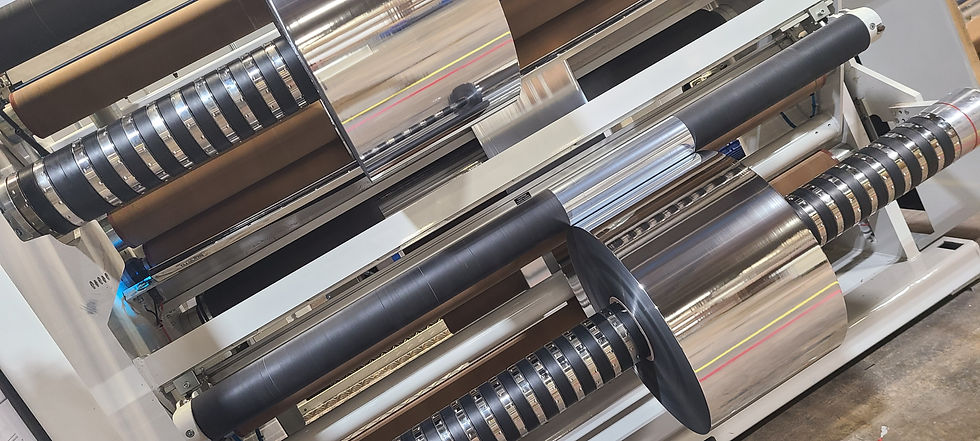
StockPKG Films supports customers with converting needs including in-house slitting, which helps align roll specs to the realities of the line and reduce avoidable converting-related issues.
What Buyers Should Validate Before Committing
A metalized film decision should be validated under real conditions. The most expensive mistakes are the ones that look fine on paper but fail at scale.
Here is a practical buyer-focused checklist.
1) Define the shelf-life driver
Before you evaluate material, define what you are solving:
Oxygen-driven staling or oxidation
Aroma loss or flavor fade
Light sensitivity
Moisture-driven texture loss
If you do not define the driver, you will not know what success looks like.
2) Validate performance at production speed
Do not rely on a slow trial. Run at normal conditions and capture results that procurement and QA can sign off on:
Line speed stability
Registration performance
Waste and scrap impact
Package appearance consistency
3) Confirm converting fit
Metalized films often require tighter discipline in converting. Validate what matters to your process:
Roll geometry and core requirements
Edge quality and roll build
Handling sensitivity and scuff resistance
Lamination performance expectations
4) Confirm barrier and protection targets that matter
Barrier is not one number. Align the evaluation to what your product actually needs, and document pass/fail targets.
Practical Questions to Ask During Sourcing
When evaluating metalized films or METPET options, these questions tend to surface risk early:
What applications has this film performed well in, and where has it struggled?
What web handling and tension ranges are typical for stable registration?
What are the most common appearance defects, and what prevents them?
What converting requirements matter most (slitting, roll build, storage, handling)?
What should we measure during a trial so we do not miss early warning signs?
How StockPKG Films Fits Into Metalized Film Programs
Most successful programs treat metalized films as part of a structure and a process, not a standalone material swap. StockPKG Films supports food packaging teams evaluating METPET films and related flexible packaging film options, with the ability to align material selection with converting and roll requirements.
If you are considering a metalized structure, the fastest way to reduce risk is to pair the material evaluation with a real production trial that includes printing and converting realities, not only lab metrics.
Closing Thought: Make the Decision Based on Total Cost, Not Only Roll Price
Metalized films can protect shelf life and product quality in ways that matter commercially. They can also increase cost if the process window tightens and scrap rises. The best decisions are the ones tied to a defined shelf-life driver, validated at production speed, and supported by converting discipline.
If you are evaluating metalized films for a food packaging application, define the problem first, then validate barrier, appearance, and registration performance under real conditions before scaling.


