


Good Slitting Is Invisible. Bad Slitting Shuts You Down

Most converters, printers, and packaging manufacturers don’t spend much time thinking about slitting when things are running well.
That’s not an oversight. That’s the goal.
When slitting is executed properly, it becomes invisible to the operation. Rolls unwind clean, edges track the way they should, and machines run without constant intervention. Operators focus on production—not troubleshooting. Output remains consistent, predictable, and efficient.
But when slitting is done poorly, it does not stay hidden for long. It surfaces quickly, disrupts production, and often gets misdiagnosed as something else entirely.
Why Slitting Rarely Gets the Attention It Deserves
In most facilities, performance issues are addressed at the point where they become visible. That usually means the press, laminator, or converting line.
Operators see:
Web breaks
Edge weave
Inconsistent tension
Registration issues
Excessive waste
Naturally, adjustments are made at the machine level. Speeds are reduced. Tension is modified. Settings are tweaked.
But in many cases, these are not root-cause fixes. They are compensations.
The real issue started earlier—at the slitting stage.
Slitting defines how a roll behaves long before it reaches production. If the roll is inconsistent, no amount of machine optimization will fully correct it. Instead, the entire operation is forced into a reactive state.
What “Good” Slitting Actually Looks Like
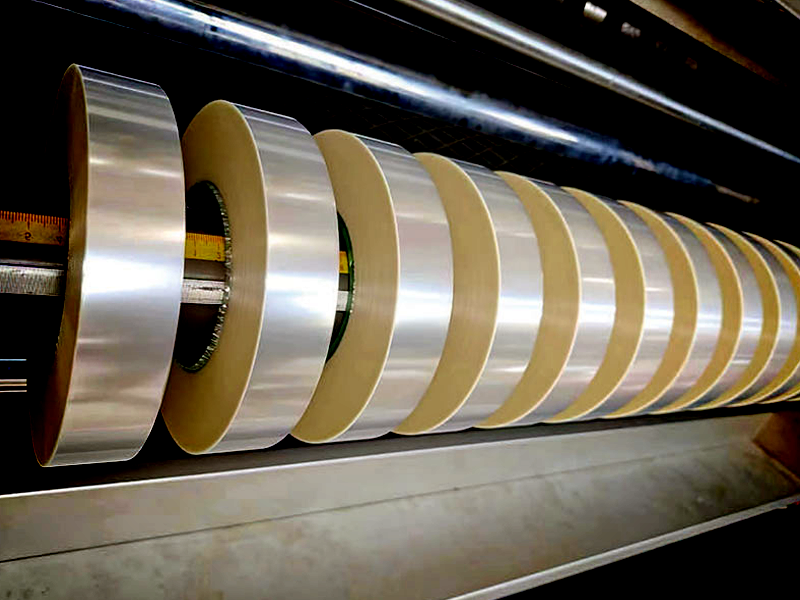
Good slitting is not just about cutting material to width. It is about controlling how that material performs throughout the entire downstream process.
When slitting is done correctly, several key characteristics are present:
1. Clean, Consistent Edges
Edge quality directly impacts how material tracks through equipment. Poor edges can lead to:
Edge curl
Fraying or dusting
Tracking instability
Clean edges, by contrast, support smooth web handling and reduce the likelihood of defects or breaks.
2. Uniform Tension Across the Roll
Tension inconsistencies create immediate challenges on press and converting lines. Variations lead to:
Uneven unwinding
Wrinkling
Difficulty maintaining registration
Consistent tension ensures the material behaves predictably from start to finish.
3. Proper Roll Build
Roll structure is one of the most overlooked aspects of slitting. A poorly built roll can cause:
Telescoping
Core crushing
Loose or overly tight winding
A properly built roll maintains integrity during transport, storage, and production, allowing for stable unwinding.
4. Repeatability Across Runs
Consistency is critical. It is not enough for one roll to perform well. Every roll must perform the same way, every time.
Repeatability eliminates variability, which is one of the largest hidden costs in manufacturing.
What Happens When Slitting Goes Wrong
Bad slitting introduces instability into the system. And once that instability enters production, it spreads.
1. Increased Downtime
Unexpected stops are one of the most immediate consequences. Web breaks, tracking issues, and tension problems force operators to pause production and reset.
2. Operator Compensation
When material is inconsistent, operators adapt. They:
Slow down machine speeds
Adjust tension frequently
Monitor runs more closely
This compensation may keep production moving, but it reduces efficiency and increases labor intensity.
3. Higher Waste Levels
Inconsistent material leads to:
Start-up waste
Mid-run defects
Scrap from failed runs
Waste is not just a material cost—it is a time cost and a capacity cost.
4. Misdiagnosed Equipment Issues
One of the most expensive outcomes is misdiagnosis. Companies may:
Service machines unnecessarily
Replace components prematurely
Invest in equipment upgrades that do not solve the problem
All while the root cause remains unchanged.
The Compounding Effect of Poor Slitting
Slitting issues rarely exist in isolation. They compound over time and across processes.
A single inconsistent roll can:
Slow down an entire shift
Increase wear on equipment
Create variability in finished products
Impact delivery timelines
When this happens repeatedly, it erodes overall operational efficiency.
The problem is not always dramatic. In many cases, it is subtle:
A few percentage points of lost speed
Slightly longer changeovers
Incremental increases in waste
But over time, these small inefficiencies add up to significant losses.
Shifting the Focus Upstream
Improving performance on the production floor is important—but it is only part of the equation.
True efficiency gains often come from addressing upstream processes, starting with slitting.
When slitting is controlled and consistent:
Machines run closer to optimal speeds
Operators spend less time adjusting and more time producing
Waste is reduced
Output becomes predictable
Instead of reacting to problems, operations become proactive and stable.
Slitting as a Controlled Process
Treating slitting as a controlled process rather than a final step changes how materials perform throughout the supply chain.
This approach requires:
Tight tolerance control
Consistent process parameters
Proper equipment setup and maintenance
Quality checks that ensure repeatability
It is not simply about cutting rolls. It is about engineering consistency into the material before it ever reaches production.
Why “Invisible” Is the Benchmark
The best slitting operations are the ones no one talks about.
There are no emergency adjustments. No unexpected stops. No ongoing troubleshooting.
Material runs the way it is supposed to, and production continues without interruption.
That is what “invisible” looks like.
By contrast, bad slitting is impossible to ignore. It disrupts workflows, creates uncertainty, and forces teams into constant problem-solving mode.
Evaluating Your Current Operation
If your team is experiencing ongoing production challenges, it is worth asking a few key questions:
Are operators frequently adjusting machines to maintain stability?
Are web breaks or tracking issues occurring more often than expected?
Is waste higher than it should be without a clear explanation?
Are equipment issues being addressed repeatedly without lasting improvement?
If the answer to any of these is yes, the root cause may not be on the production floor.
It may be upstream.
The Bottom Line
Slitting is not just a preparatory step. It is a foundational process that determines how material performs across every downstream operation.
When done well, it disappears into the background and allows production to run efficiently. When done poorly, it becomes a constant source of disruption. The difference between the two is not subtle.
It is the difference between running and stopping.


